
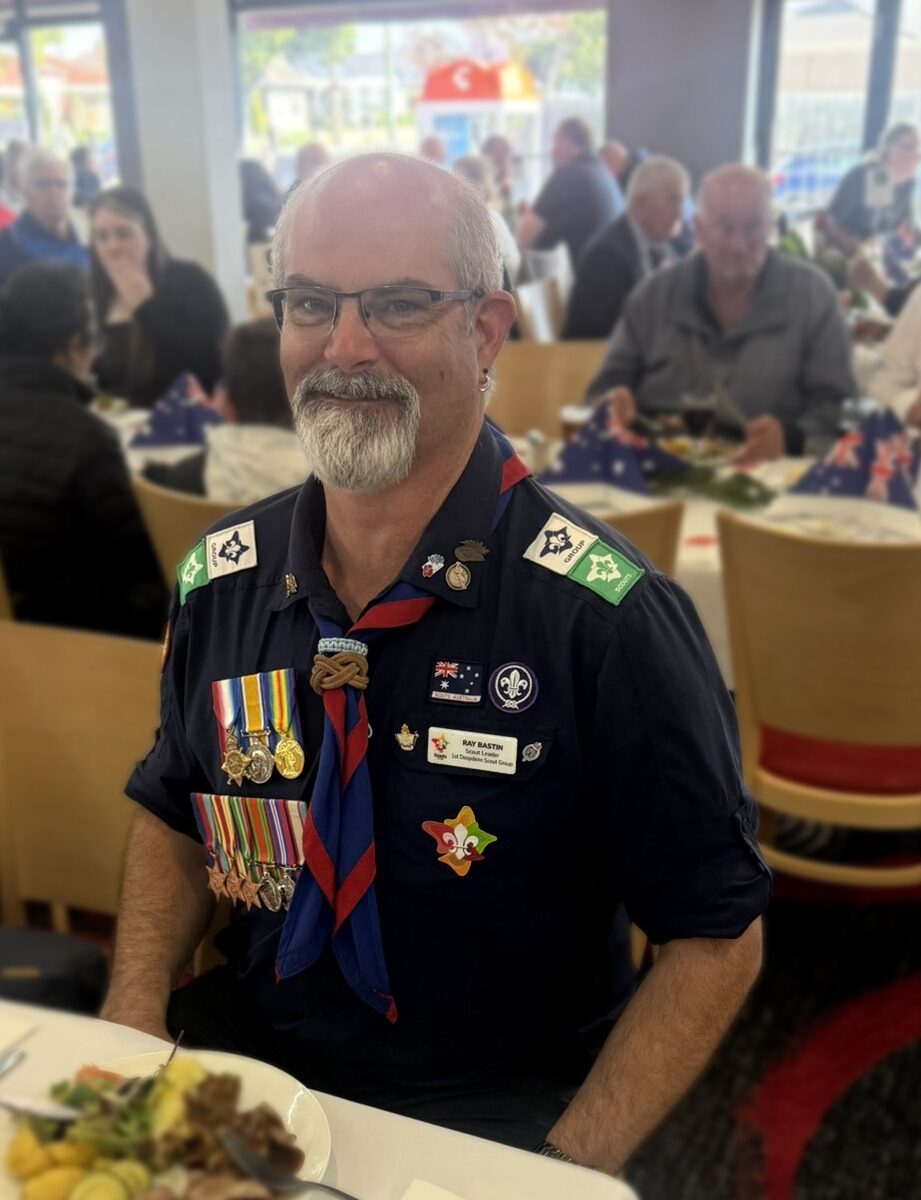
An address delivered by Ray Bastin, Group Leader of 1st Deepdene Scouts, after the Springvale RSL ANZAC Commemorative Service on Sunday 19 April 2026 (Springvale Town Hall Gardens and Cenotaph). Shared here with permission.
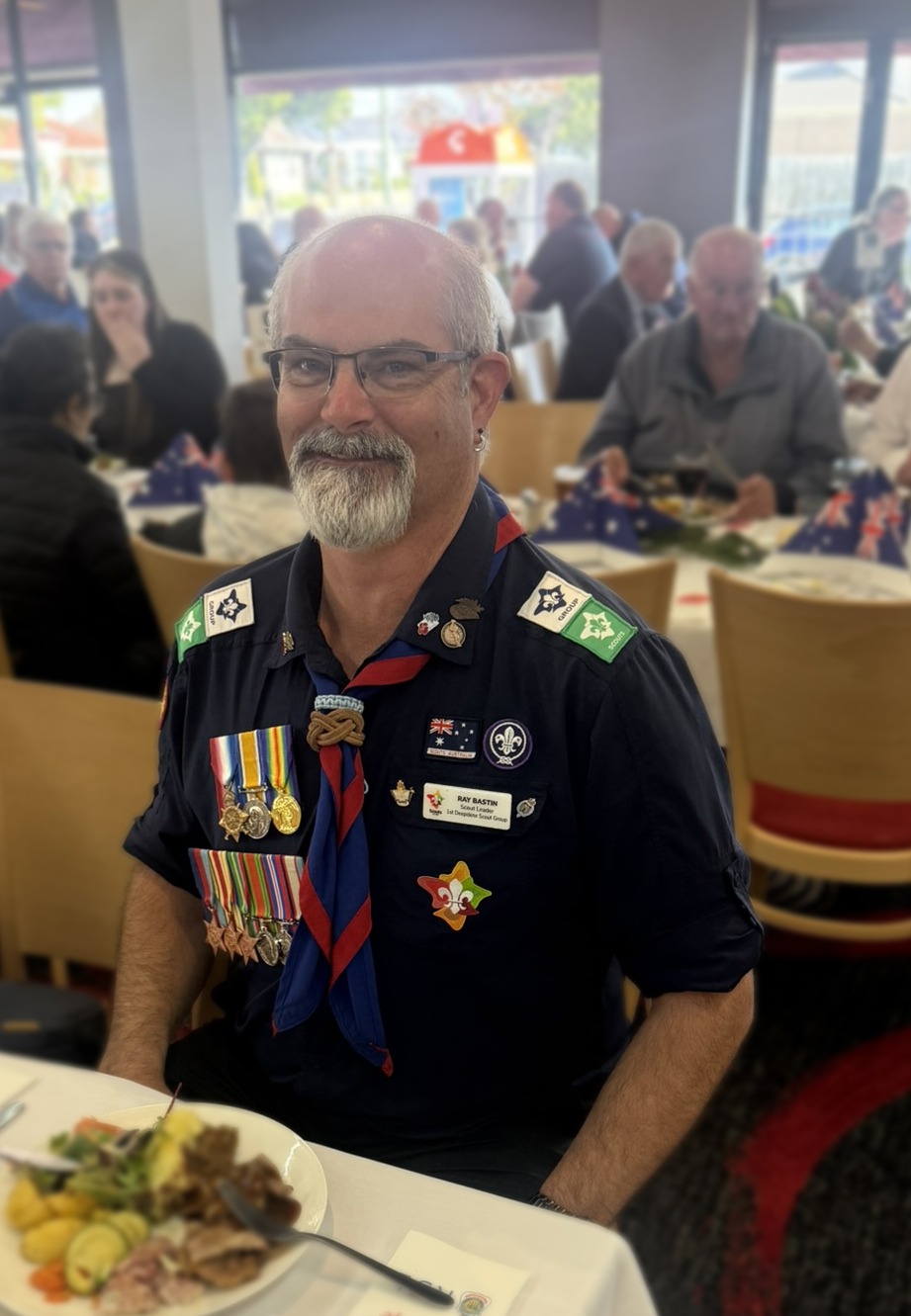
Good afternoon. When my father-in-law asked me to speak today about my connection to ANZAC Day, it sparked a lot of reflection. My name is Ray Bastin, I am Group Leader at 1st Deepdene Scouts, and today I’d like to share how the spirit of ANZAC Day resonates with me and my journey in leadership and community service.
I remember growing up with the stories of family members serving in the armed forces. My father Ron spent 6 years in the Air Force. My Grandfather, William (Bill) Bastin went off to the second world war in 1940. He fought in Palestine and then in New Guinea. A couple of his brothers also went off to war, one convincing the Army he was 18 when he joined. At the end of WW2, he decided to stay in, going on to fight in other wars during his career.
But for all the stories I heard, there was one that has stuck with me more than others. It is the story of one of Bill’s older brothers, William James Archibald Bastin, better known as Arch. He joined up in July 1915, and he went Missing in Action in 1916 only to be listed as Killed in Action a year later. He had died somewhere in France. I remember being told his mother always believed he was still alive and living somewhere in Europe, but I believe it was because she couldn’t bear the pain of losing her son.
The story of my great uncle Arch stayed with me over the years, and I found little snippets of information that kept stirring my interest in his story.
Finding Arch
On my first trip to Canberra about 15 years ago, we went to the Australian War Memorial. I remembered that Arch’s name was listed somewhere. On walking into the memorial, I remember looking at all the names and enormity of the task of finding him struck me. Luckily you can do a name search, and with the help from some friendly staff members, we were able to locate his name. The emotion I felt surprised me. This started a desire to find out more about his life.
He was born in 1898. When he enlisted in July 1915, he said he was 18 years 5 months, there was a signed note from his parents attesting to it. His first unit was with the 9th Reinforcements 8th Battalion. He left Australia on 15 September 1915 and landed at ANZAC Cove on 7 December 1915. I know they saw action on their first day, because in the War Diary it mentions that 8th & 9th Reinforcements joined the 8th Battalion, with the loss of a Lieutenant and 1 man from the 9th, 2 other men wounded.
Along with the rest of the Australians, he was evacuated later that month. He arrived in Alexandria on 7 January 1916. In February he was transferred to the 60th Battalion and a month later the 59th. He spent the next few months in Egypt at the Suez Canal. During this time, he was admitted to hospital with an ingrown toenail, an affliction I suffered from when I was 16.
On 18 June 1916 he left Alexandria, arriving in Marseilles 11 days later. A train ride later he found himself on the Western Front in a little town called Fromelles in the north east of France.
On the night of 19 July 1916, the newly arrived Australian troops were sent into action. The men were sent over the top at 6pm in 4 waves at 5-minute intervals. The German trenches were 400m away. The next morning, he was listed as Missing in Action. A year later, at a Court of Enquiry, he was listed as Killed in Action — Presumed buried in No Man’s Land.
He was just one of the 5,533 casualties from that action, with almost 2,000 killed.
A journey of discovery
Just over 2 years ago, we planned a family holiday to France. Besides the usual tourist sites, I wanted to go to Fromelles to find my Great Uncle. My wife Kris, the event planner that she is, researched the Western Front to include other things into our itinerary. In April 2024, Kris, our son Archer and I, along with Kris’s parents, went to France.
Our journey of discovery started in Ypres, Belgium. The In Flanders Fields Museum was the most interesting museum I have ever been in. It reflected on the fact that on the battlefield, the line between winning and losing is blurred by shared sacrifice. Even the victor returns with a piece of themselves missing, but the lessons of service and the scars of history remain. It displayed the First World War as it was — no winners, no glory, just men and women who gave their lives in the name of service and those who had to sacrifice their lives when the war was fought on their doorstep.
Whilst staying in Ypres, we attended the daily Last Post Ceremony at the Menin Gate, where we laid a wreath on behalf of the 1st Deepdene Scout Group. It was bitterly cold that day and standing and talking with others who were laying wreaths for their own reasons, we all realised we had connections to this area through family who had seen combat there. It was then I realised many have their own stories of family who went to war and never returned home.
A couple of days later we travelled to Fromelles. A look around the Museum, a wander through the Pheasant Wood cemetery and others dotted around the French countryside, and my mind was thinking of Great Uncle Arch. How the landscape he saw would have looked very different from the idyllic farmland there now. We made our way to VC Corner, the Cemetery and Memorial where his name is listed. The Cemetery contains 410 unidentified bodies that were retrieved from the battlefield two years after the battle. The only known thing about them is they were all Australian. The Memorial lists 1,300 Australian soldiers who were lost in the battle and who have no known resting place. It is also the closest cemetery to where the 59th Battalion fought.
I found Arch’s name rather quickly, and after some quiet reflection and laying a poppy, I looked out over the surrounding fields, which were once no man’s land. There was a peacefulness in the place. The canola flowers hiding any evidence of its gory past. There was a freshly tilled paddock on one side and it was easy to imagine how thick the mud would be once it rained.
Villers-Bretonneux
On ANZAC Day 2024, I rose earlier than I usually do on this day. As a family, we made our way for the Dawn Service at Villers-Bretonneux. It was a service that I will remember forever — not that it was much different from others, but for the crowd it draws. You had your Aussies and Kiwis, but there were more French citizens in the crowd than I had expected. It was also very sobering to attend a service where our troops had actually been and fought.
The town of Villers-Bretonneux has an interesting connection with Australia, and in particular Victoria. Many Victorian soldiers were stationed here and billeted by local families, but like much of France, the town suffered damage. Surviving soldiers stayed on and with the help of their families and communities back home, raised funds to rebuild the school. The school still stands today and has a memorial that says “Never forget Australia”. On ANZAC Day the town was filled with Australian and French flags and seeing the way the French look after all the fallen, it was truly a humbling experience.
Lest we forget
To the Scouts I lead, I strive to convey that ANZAC Day is not about celebrating conquest, but about the solemnity of reflection. I want them to understand that in war, there are no true winners. For every battle won, something precious is lost — even by the victor. I teach them that while glory is fleeting, the cost of that glory is permanent.
ANZAC Day is a day we should use to honour those men and women who have served their country, in times of peace and war, and above all, remember those who have fallen. If we forget them, then they are truly gone and we are doomed to make the same mistakes of the past.